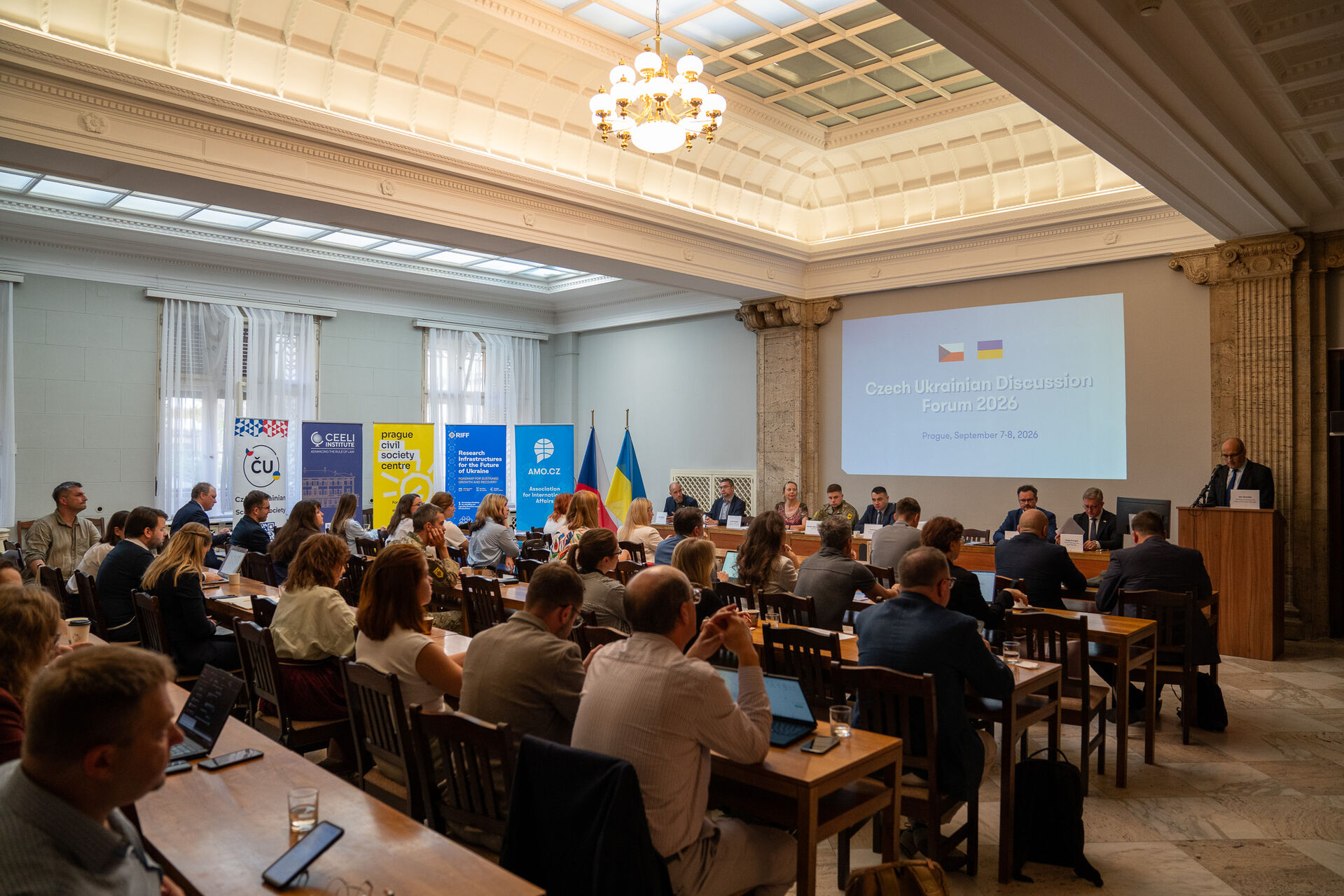
We, the participants of the fourth Czech-Ukrainian Forum, having physically assembled in the city of Prague on 7-8 September 2026,
Denouncing the ongoing Russian war of aggression against Ukraine and violations of international law, leading to swiftly deteriorating international environment;
Recognising the persistent danger brought by the Russian aggression against Ukraine, Czechia and the EU, in particular the threat posed by Russian malign activities including hybrid threats, sabotage, propaganda and disinformation campaigns have increased, become overt and with substantial material effects and with risks to lives of EU citizens in 2026;
Agreeing on the need to hold Russia accountable for its international crimes and all possible ways of conducting aggression against Ukraine, including the illegal annexation of sovereign territories of Ukraine by Russia;
Acknowledging the utmost importance of Ukraine’s independence and sovereignty for the security of Europe and the rules-based international order;
Considering the importance of international efforts to bring just and lasting peace to Ukraine by the coalition of the willing;
Noting the importance of successful implementation of reforms in Ukraine as a key pathway into the EU based on the ongoing enlargement process;
Being aware of the experience Czechia gained during the process of preparation for EU and NATO membership and how valuable this transformation experience is for contemporary Ukraine on its way into the EU and NATO;
Noting the enormous progress achieved in bilateral relations between Czech and Ukrainian civil society organisations and increasing number of volunteer over the past years, especially in such areas as civil-military cooperation, humanitarian aid and development assistance, joint historical research, the fight against foreign malign influence and other hybrid threats;
Drawing on the need to continue and further develop strategic relations between the Czech Republic and Ukraine, with a particular focus on people-to-people contacts, including in the area of civil society, business as well as academia and youth;
Highlighting that in the coming winter of 2026/27 Ukraine will be targeted by an extensive Russian air campaign without necessary air defences and will face an expected Russian mobilisation wave.
Have hereby agreed to:
- Urge the Czech government to encourage and actively support engagements between Czech governmental, military or security leaders and their Ukrainian counterparts in order to exchange lessons from the experience of Ukraine;
- Continue working at the societal level and exchanging best practices between Czechia and Ukraine at the level of citizens and communities, as civilians and civilian structures should be included in crisis management and planning, including training for the society;
- Maintain strong relations between Ukrainians living in Ukraine and Ukrainians currently living in Czechia to facilitate good contacts, promote understanding and mobilise support for Ukraine both inside and outside the country;
- Highlight the importance of public and strategic communication by the Czech and Ukrainian state authorities, including when strengthening societal resilience;
- Continue working towards necessary energy decoupling from Russia and investing in domestic renewables to provide affordable energy sources that can be easily distributed, all outside of the control of authoritarian countries;
- Encourage diversification, logistics, and preparation of businesses, especially in terms of economic planning and crisis management;
- Encourage the Czech Government to make use of Ukrainian experience to update and improve crisis legislation for more flexible and faster mobilisation of personnel and production capacities and incorporate the changes of military technology and doctrine which Ukraine is willing to share;
- Highlight that Europe in general, and the Czech Republic in particular, must invest the resources and build enough available, flexible and scalable military capacities to create a credible deterrent to Russian aggression, including the capacity to respond effectively even in circumstances of reduced US involvement;
- Call for the exchange of knowledge and support for building capacities to increase the production of more, cheaper, and adaptable defence equipment, particularly unmanned systems. Support EU defence procurement reform to reduce fragmentation and increase collaboration within the defence-industrial complex;
- Urge the Czech Government as well as other EU governments to use national guarantee institutions to de-risk investment and co-production with Ukraine in defence industry and allow Ukrainian and joint companies to participate in Czech and other EU defence procurements, early communicating capacity needs and identifying concrete capability areas for Ukraine’s participation;
- Urge the Czech and other EU governments as well as other relevant stakeholders to look for ways to support the civil defence and resilience of Ukraine, mainly in the area of energy production, support export corridors, and EU land connectivity projects, including both funding and EU level diplomacy effort;
- Propose continuation of initiatives and mechanisms to secure financial and military support for Ukraine in a sustainable and long-term manner, while at the same time eliminate regulatory burdens particularly for high priority defence projects in cooperation with Ukraine;
- Call on the EU and NATO members to mobilise reserves of available air defence systems to supply to Ukraine over the coming winter months;
- Acknowledge that some of our essential technologies (UAVs, semiconductors, rare earths, etc.) too often depend on China, which is the main enabler of the Russian war effort. Therefore, it is necessary to make substantial efforts to substitute this Chinese production and significantly reduce dependency on China;
- Understand that China is also rapidly incorporating, testing and integrating military and technological lessons from the Russian war on Ukraine, while increasing technological support for Russian war machine against Ukraine - capacities that could potentially be used against European countries;
- Propose to explore common projects on a local level to support and to learn from wartime law enforcement and consequences of the war at the local level; -
- Strengthen the Czech-Ukrainian cooperation in science, research and education by supporting joint research projects, academic exchanges, cooperation among universities and research institutions, and the exchange of expertise and knowledge, particularly in areas relevant to Ukraine’s recovery, European integration, security and resilience;
- Encourage the Czech government to support grassroots projects in humanitarian aid, cultural exchange, capacity building and reconstruction among municipalities, regional governments, state institutions and organisations and civil society organisations to build on the outsize recognition of Czech support to Ukraine that can be later transformed into more extensive cooperation for a faster reconstruction of Ukraine;
- Encourage additional investment in the presence of international observers and European police officers in Ukraine, which currently remains entirely insufficient. Without a direct presence on the ground, we are losing knowledge, experience and skills. This concerns both war crimes and corruption or organised crimes at various levels. International cooperation and support can have a positive impact, as we see in the work of the National Anti-corruption Bureau of Ukraine (NABU), Specialized Anti-Corruption Prosecutor's Office (SAP) or the State Bureau of Investigation (DBR),
- Adopt and uphold sanctions against individuals and entities involved in violations of international law committed in the context of Russian aggression against Ukraine, building up coordination of sanctions regimes,
- Reaffirm unconditional and principled support and cooperation with the ICC, especially in the investigations related to the situation in Ukraine, and encourage tangible measures to mitigate the impact of the measures taken by the US,
- Continue to support further accountability for violations of international law in the context of Russian aggression against Ukraine through a variety of mechanisms, including supporting documentation, international tribunals, national prosecutions (including universal jurisdiction), Ukrainian domestic prosecutions, as well as financial mechanisms such as international sanctions, asset freezing, and the Registry of Damage for Ukraine.